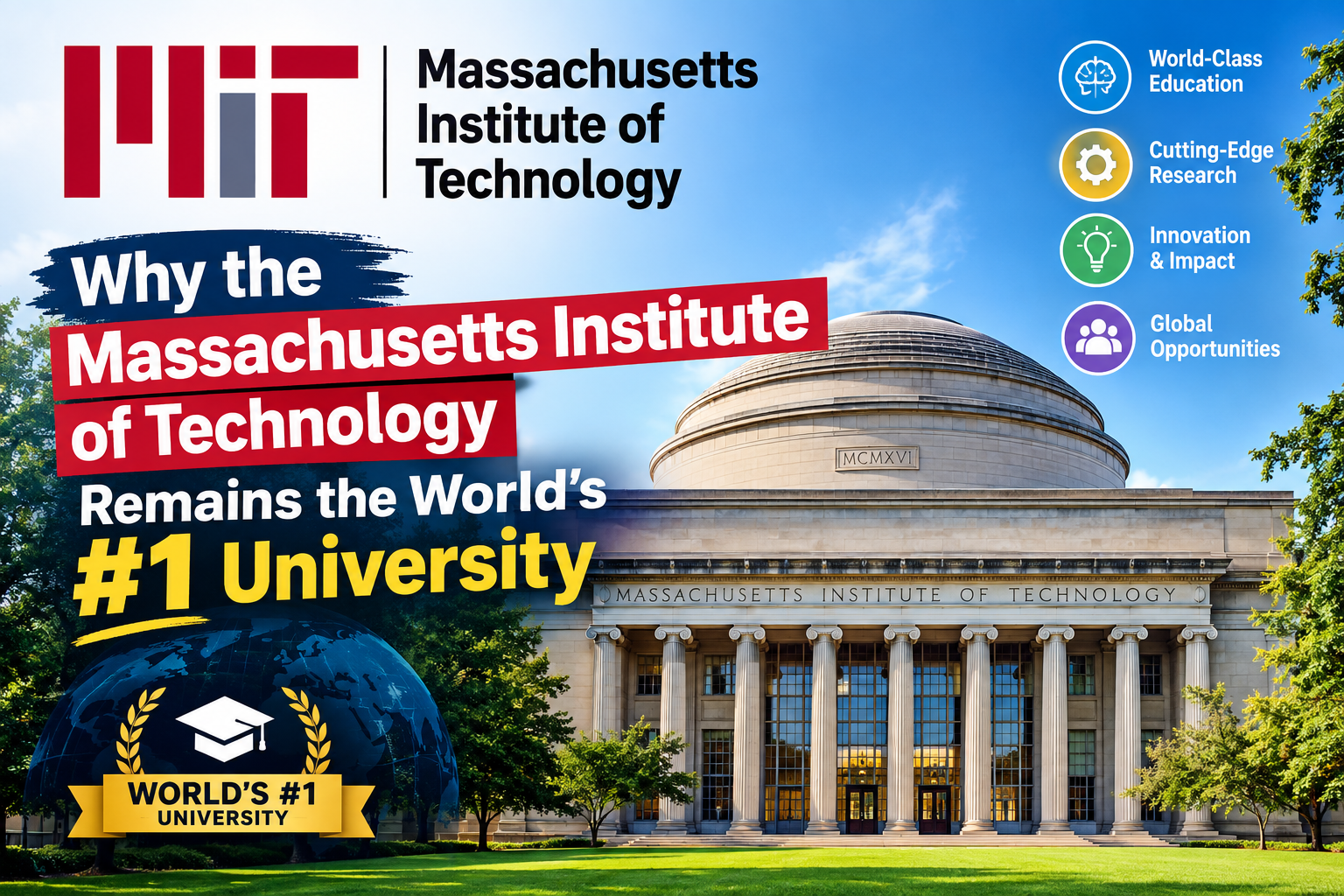
If you’ve spent any time researching global university rankings, you already know the name that keeps showing up at the very top. For fourteen years running, the Massachusetts Institute of Technology has held the number one spot in the QS World University Rankings — a streak that no other institution on earth has managed to match. That kind of consistency isn’t luck. It comes from a very specific culture that MIT has built over more than 150 years, one that rewards curiosity, tolerates failure, and pushes students toward problems that don’t have easy answers.
A Short History Worth Knowing
MIT was founded in 1861 in Boston, at a time when American higher education was still mostly built around Latin, theology, and classical texts. William Barton Rogers, the school’s founder, had a different idea. He wanted a place where science and practical engineering sat at the center of the curriculum, not the edges. The school later moved to Cambridge, Massachusetts, in 1916, and it’s been there ever since, right along the Charles River, facing Boston across the water.
That founding philosophy — “mens et manus,” mind and hand — still shapes how the place runs today. Students aren’t just expected to understand theory. They’re expected to build things, test them, break them, and rebuild them.
What Makes the Academics Different
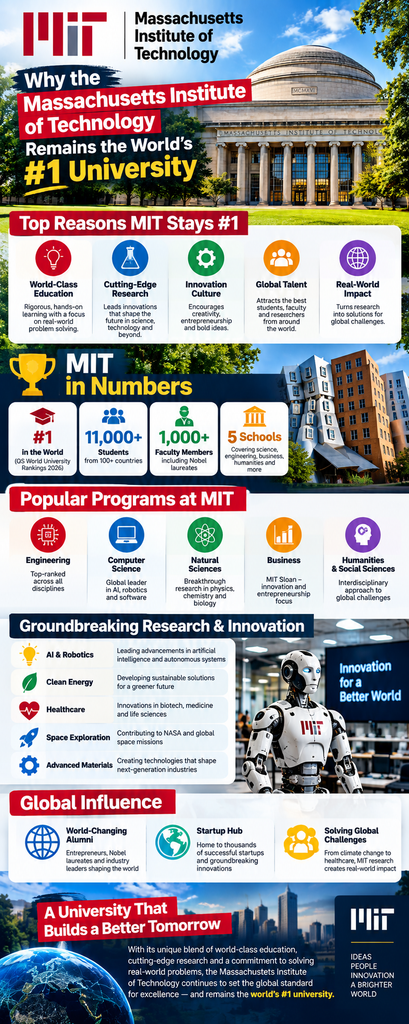
MIT is organized into five schools, covering everything from architecture and humanities to management, science, and its flagship School of Engineering. But what really stands out is how interconnected these departments are. It’s common for a computer science student to end up in a biology lab, or for a mechanical engineering major to take a class cross-listed with the Media Lab.
Some of the programs that consistently pull in the strongest applicants include:
- Electrical Engineering and Computer Science (EECS) — by far the most popular major on campus
- Physics, where MIT has produced dozens of Nobel laureates
- Economics, which has quietly become one of the strongest departments in the country
- Aerospace Engineering, tied closely to research partnerships with NASA and private space companies
Class sizes tend to be small for a research university this size, and undergraduates get pulled into real research projects far earlier than at most other schools — often by sophomore year.
Why the Rankings Keep Favoring MIT
QS ranks universities using a mix of academic reputation, employer reputation, faculty-to-student ratio, research citations, and international outlook. MIT scores near the top of almost every one of these categories, but its research output and citations per faculty member are what really separate it from close competitors like Stanford or Imperial College London. Faculty here produce an outsized volume of highly cited papers relative to the size of the institution, and that efficiency is exactly what ranking bodies reward.
Getting In
MIT’s admissions process is need-blind for domestic applicants and famously selective — acceptance rates hover around 4%, among the lowest of any university in the world. The application leans heavily on demonstrated problem-solving ability rather than a polished resume. Standardized testing requirements have shifted in recent years, so it’s worth checking MIT’s own admissions page for the current cycle rather than relying on outdated information floating around online.
International applicants make up close to a third of the undergraduate population, which tells you something about how global the school’s reach really is.
Campus Life and the People Who Passed Through
MIT’s campus culture leans quirky. Hacking — in the old MIT sense of clever, harmless pranks — is practically a tradition, and dorm culture varies wildly from one residence hall to another. It’s not a school built around big-name sports programs or Greek life dominating the social scene; most of the energy goes into labs, hackathons, and student-run startups.
The alumni list reads like a who’s-who of modern science and business: Buzz Aldrin, Kofi Annan, and Ben Bernanke all passed through these halls, alongside dozens of founders behind companies you use every day.
Research Labs That Changed the World
A lot of MIT’s reputation comes down to a handful of research labs that operate almost like independent institutions under the university’s umbrella. CSAIL — the Computer Science and Artificial Intelligence Laboratory — is one of the largest research labs on campus and has quietly shaped decades of work in robotics, cryptography, and machine learning. The Media Lab takes a very different approach, blending design, technology, and art in ways that regularly produce inventions nobody expected a university lab to touch, from wearable computing to new prosthetics.
Lincoln Laboratory, MIT’s federally funded research center, works on defense and space technology and has been operating since the early Cold War era. Between these and dozens of smaller centers, MIT pulls in well over a billion dollars a year in sponsored research funding, a huge share of it from federal agencies like the National Science Foundation and the Department of Defense, along with a growing amount from private industry partnerships.
This research infrastructure matters for undergraduates too, not just graduate students. MIT’s UROP program — the Undergraduate Research Opportunities Program — places first-years and sophomores directly into paid research positions inside these labs, something most universities reserve for juniors and seniors, if they offer it at all.
Cost and Financial Aid
Sticker price at MIT sits above $85,000 a year once you add tuition, housing, and fees together, which understandably scares off a lot of families before they even look closer. The reality for most admitted students looks very different. MIT meets 100% of demonstrated financial need for every admitted student, and families making under roughly $140,000 a year typically pay nothing toward tuition at all. Because the admissions process is need-blind, a family’s financial situation never factors into whether a student gets in — it only affects what they’re asked to pay afterward.
This matters because MIT’s average student debt at graduation is lower than at many state schools, despite the eye-watering headline price tag.
How MIT Compares to Its Closest Rivals
Stanford and MIT get compared constantly, and for good reason — both sit near the top of every engineering and computer science ranking on earth. The difference tends to come down to culture and location rather than academic quality. Stanford’s sprawling campus and closeness to Silicon Valley venture capital create a slightly more entrepreneurial, laid-back atmosphere, while MIT’s dense urban campus and closer ties to federal research funding push it toward a more research-first, technically intense culture. Neither is objectively better — it really comes down to what kind of environment a student thrives in.
Against Imperial College London, the comparison shifts. Imperial is narrower in scope, focusing almost entirely on STEM and medicine, while MIT still runs strong programs in economics, linguistics, and even a respected school of architecture. Students choosing between the two often end up deciding based on country and campus culture rather than pure rankings, since both sit within a point or two of each other in most metrics that matter.
A Few Tips for Prospective Applicants
Because MIT’s process weighs problem-solving ability so heavily, essays here tend to reward specificity over polish. Admissions officers have said publicly, more than once, that they’d rather read about a small, oddly specific project a student built than a vague statement about “always loving science.” Standardized test policies shift from year to year, so checking MIT’s own admissions site for the current cycle’s requirements is worth doing rather than trusting secondhand summaries.
It’s also worth noting that MIT superscores neither the SAT nor ACT in the way many other schools do, and its supplemental essays are shorter and more numerous than what applicants usually expect — five short essays rather than one long personal statement, each aimed at a different side of a student’s personality.
The Bottom Line
MIT isn’t the right fit for every student — the workload is intense, and the culture rewards a very particular kind of relentless curiosity. But if you’re looking at the world’s best universities and wondering why one keeps holding the top spot year after year, the answer is fairly simple: MIT built an entire institution around solving hard problems, and it hasn’t stopped since 1861.