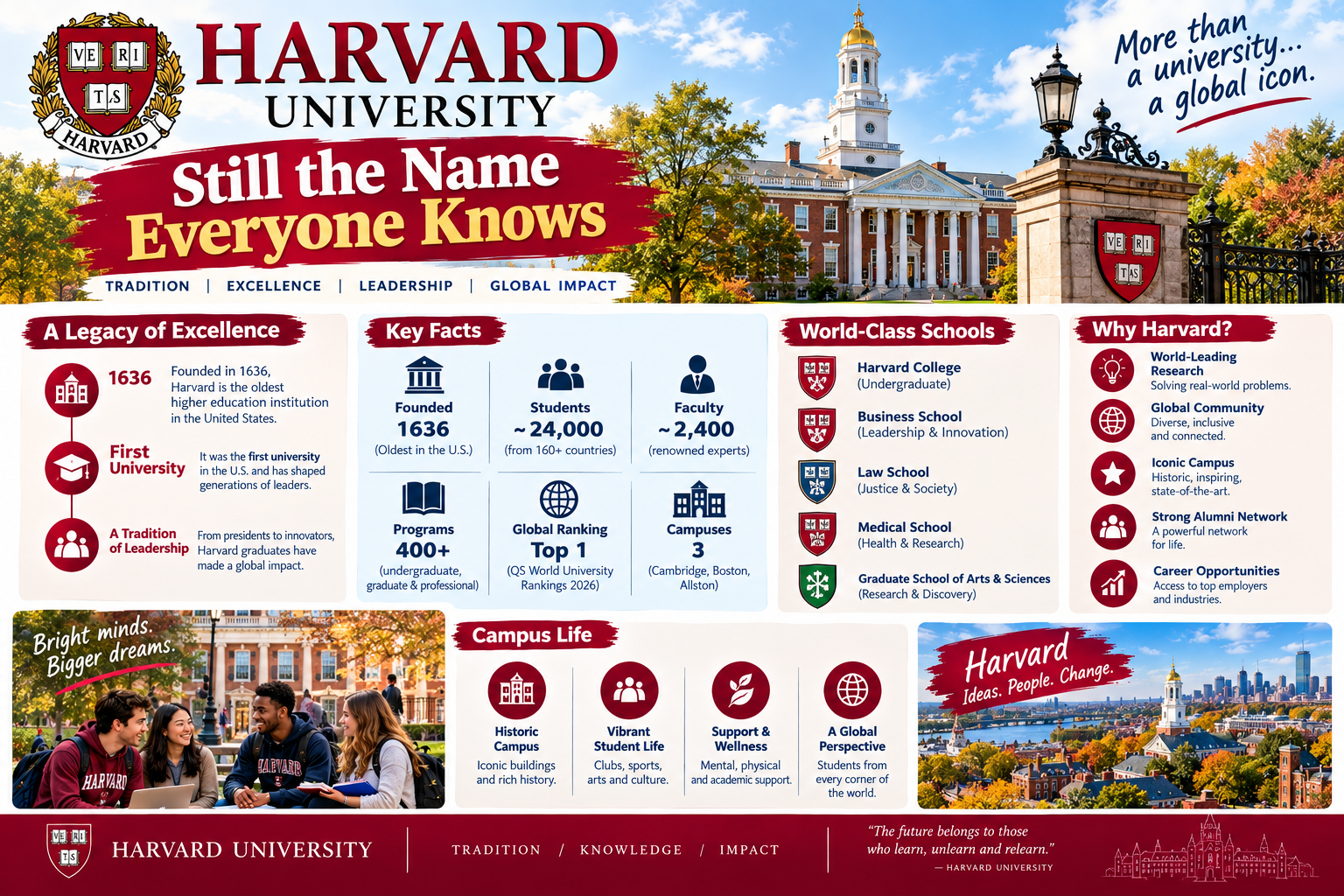
Say the word “university” to almost anyone on the planet, and there’s a good chance Harvard is the first name that comes to mind. That kind of global name recognition isn’t something rankings measure directly, but it’s hard to separate from why Harvard continues to sit at fifth place in the QS World University Rankings 2026, just behind Oxford and ahead of Cambridge.
America’s Oldest University
Harvard was founded in 1636, making it older than the United States itself by 140 years. It started as a small school for training Puritan clergy in colonial Massachusetts and grew, over nearly four centuries, into the institution most people associate with academic prestige more than any other in the world.
That history matters practically as well as symbolically. Harvard’s endowment — the largest of any university on earth, worth tens of billions of dollars — traces back to centuries of accumulated donations and investment. That kind of financial depth funds research, financial aid, and faculty recruitment in ways very few institutions can match.
Where Harvard Leads
Harvard’s academic reach spans nearly every discipline, but a handful of schools within the university carry particular weight:
- Harvard Business School, widely considered the benchmark MBA program worldwide
- Harvard Law School, producing an outsized share of US Supreme Court justices and major political figures
- Harvard Medical School, tied to some of the best teaching hospitals in Boston
- The Faculty of Arts and Sciences, covering everything from economics to government to the physical sciences
Undergraduates at Harvard College go through a liberal arts curriculum before eventually concentrating in a specific field, a structure that encourages broad exploration before specialization — a deliberate design choice that’s remained largely unchanged for generations.
Understanding the Ranking
Harvard’s academic and employer reputation scores are about as strong as any university’s on the planet, reflecting just how deeply its name recognition and alumni network reach into governments, corporations, and academia worldwide. Where it loses a little ground to schools like MIT or Imperial is in more technical research-citation metrics, since Harvard’s academic breadth means research output is spread across far more fields rather than concentrated in a few citation-heavy disciplines.
The Admissions Process
Harvard’s acceptance rate sits below 4%, and the application process is famously holistic — testing scores, essays, extracurriculars, interviews, and recommendation letters are all weighed together rather than any single factor dominating. Financial aid at Harvard is also unusually generous; families below a certain income threshold pay little to nothing, a policy funded directly by that enormous endowment.
Cambridge, Massachusetts — Not to Be Confused With the Other One
Harvard sits in Cambridge, Massachusetts, just across the river from Boston and a short walk from MIT — the two schools’ campuses practically blend into each other along the Charles River. Student life here revolves heavily around the residential house system, where undergraduates live in one of twelve houses for most of their time at Harvard, each with its own dining hall, traditions, and community feel.
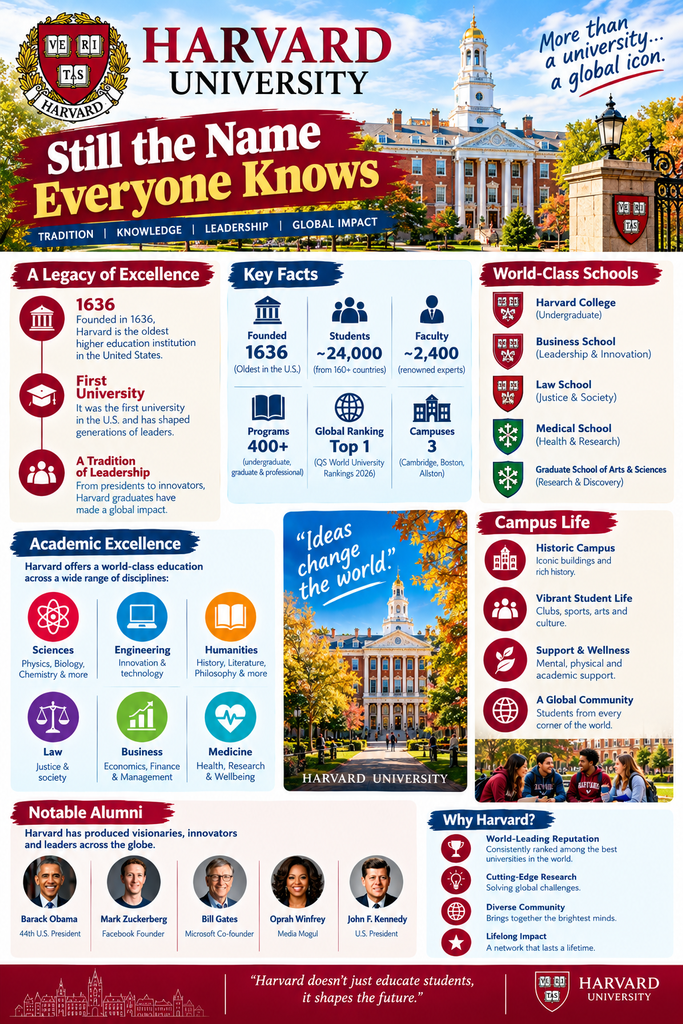
The list of Harvard alumni is almost absurdly long: eight US presidents, dozens of Nobel laureates, and a long roster of business leaders including Mark Zuckerberg and Bill Gates — both of whom, notably, didn’t finish their degrees before leaving to build their companies.
The Endowment That Funds Everything
It’s worth spending a moment on just how unusual Harvard’s endowment really is. At well over $50 billion, it’s larger than the GDP of some entire countries, managed by Harvard Management Company through a diversified portfolio of investments built up over centuries of donations. That money doesn’t just sit there — it funds a huge share of the university’s annual operating budget, covers financial aid for thousands of students, and underwrites research that would otherwise depend entirely on government grants or tuition revenue.
This financial depth is a big part of why Harvard can afford to be need-blind and meet full demonstrated financial need for every admitted student, regardless of nationality — a policy that puts real pressure on the sticker price question, since most students end up paying far less than the roughly $85,000 annual cost of attendance.
Where the Research Money Goes
Harvard’s research spending spreads across an unusually wide range of fields compared to a place like MIT or Imperial. The Wyss Institute focuses on bioinspired engineering, pulling ideas from nature into medical devices and materials science. The Harvard-Smithsonian Center for Astrophysics runs some of the most cited research in the field anywhere in the world. Meanwhile, the Kennedy School and Harvard Law School generate a different kind of influence entirely — shaping policy debates and legal frameworks well beyond campus, in ways that don’t always show up cleanly in citation-based rankings but matter enormously in the real world.
Harvard Versus Its Nearest Competitors
Stanford is the most common comparison point today, mostly because both schools compete directly for the same top applicants in business, law, and increasingly technology. Where Stanford leans hard into entrepreneurship and computer science, Harvard’s strength is more evenly distributed — its law school, business school, and medical school are each individually considered among the very best in their respective fields, which is a harder thing to pull off than excelling in one or two areas.
Against Oxford and Cambridge, the contrast comes down to teaching style and structure more than prestige. Harvard’s residential house system offers something similar in spirit to Oxbridge colleges, but the tutorial-based teaching that defines Oxford and Cambridge doesn’t really exist at Harvard — undergraduates here experience a mix of large lectures and smaller seminar-style sections instead.
Applying to Harvard
Harvard’s holistic review process means no single number — not even a perfect SAT score — guarantees admission. Admissions officers have spoken publicly about weighing “personal qualities” heavily, looking for evidence of resilience, leadership, or unusual intellectual depth in addition to strong grades. The interview, conducted by alumni rather than admissions staff in most cases, tends to be more conversational than evaluative, though it still factors into the final decision.
Early Action at Harvard is restrictive, meaning admitted students generally can’t apply early to other private universities at the same time, though it remains non-binding — students can still decline the offer in the spring if a better fit turns up elsewhere.
The Bigger Picture
Harvard’s position in the rankings reflects something rankings don’t always capture well on their own: the compounding value of nearly four centuries of reputation, resources, and a network that reaches into nearly every field of influence globally. Even as newer, more specialized institutions climb the technical metrics, Harvard’s broad-based prestige keeps it firmly in the world’s top five.