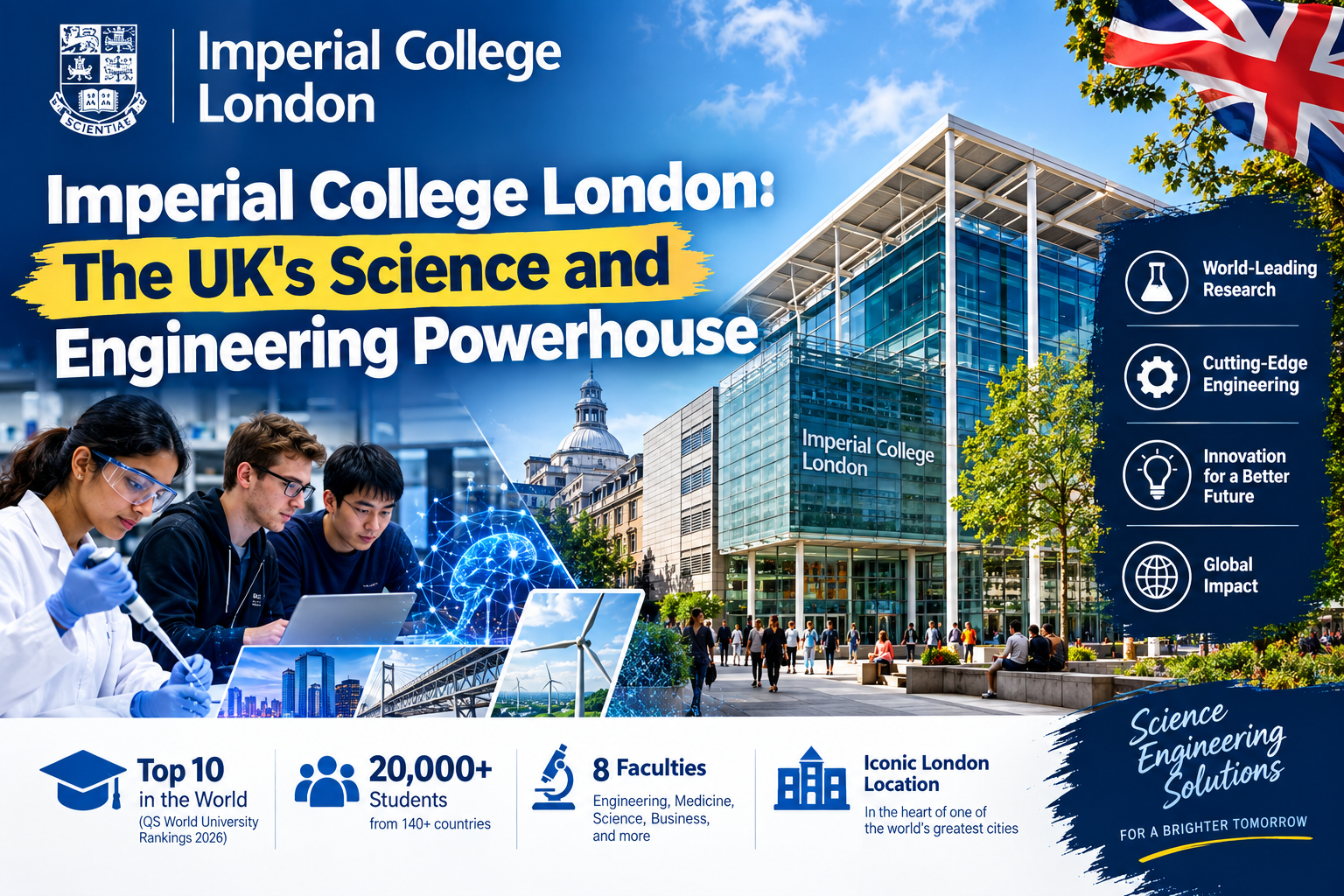
Ask most people to name a top British university, and they’ll say Oxford or Cambridge without a second thought. Yet in the QS World University Rankings 2026, it’s Imperial College London sitting at number two globally — ahead of both of those older, more famous names. That surprises a lot of people the first time they hear it, but once you look at what Imperial actually does, it makes a lot of sense.
Built With a Narrow, Deliberate Focus
Imperial was founded in 1907, formed by merging three existing London colleges focused on science, medicine, and engineering. Unlike Oxford or Cambridge, which cover practically every academic discipline under the sun, Imperial made a deliberate choice early on to stay narrow. There’s no law school here, no history department, no philosophy majors. Everything on campus points toward STEM and medicine.
That narrow focus turns out to be a huge advantage in global rankings. Resources, funding, and faculty attention aren’t split across dozens of unrelated fields — they’re concentrated almost entirely on science, technology, engineering, and medicine.
Academic Strengths
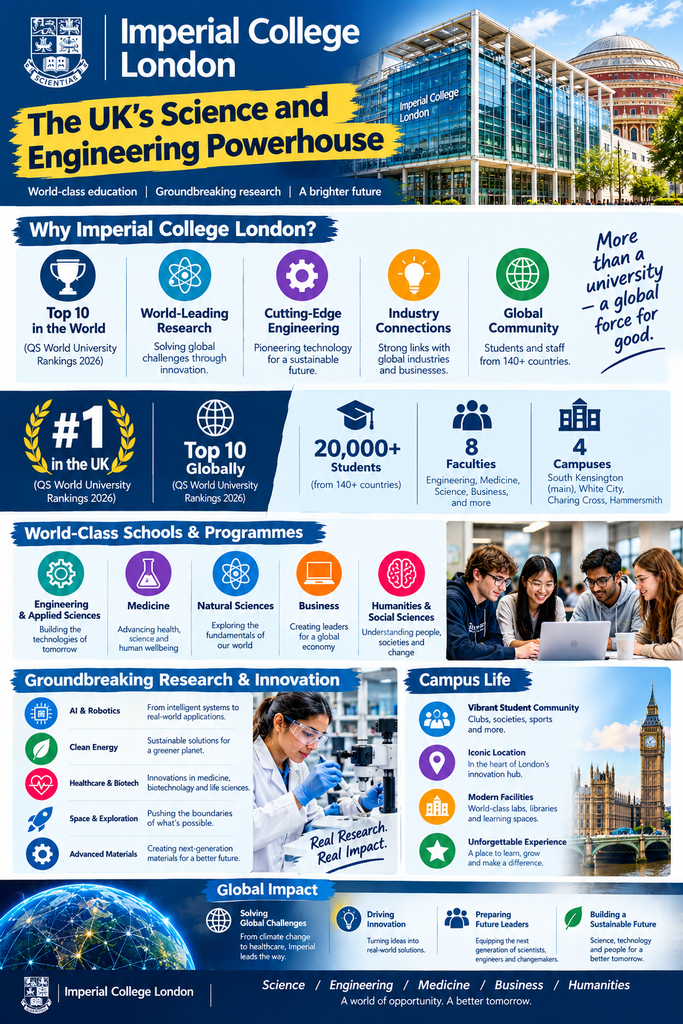
Imperial’s four faculties — Engineering, Natural Sciences, Medicine, and the Business School — cover a lot of ground despite the narrow overall focus. A few departments stand out internationally:
- Medicine, tied closely to some of London’s biggest teaching hospitals
- Computing, especially in AI and machine learning research
- Chemical Engineering, consistently ranked among the best worldwide
- Physics, with strong ties to CERN and other major research bodies
The teaching style here leans heavily on problem sets, labs, and research exposure rather than the tutorial-based essay writing that defines Oxbridge. Students often describe the workload as intense but extremely hands-on.
Reading the Rankings
Imperial’s jump to the number two global spot didn’t come from nowhere — it’s built on a genuinely strong faculty-to-student ratio, a high proportion of international students and staff, and research output that punches well above what you’d expect from a college of its size. Because Imperial concentrates so heavily on fields that generate a lot of citations (medicine, engineering, computer science), its research metrics tend to look exceptionally strong compared to broader universities.
Admissions Reality
Getting into Imperial is genuinely difficult, and it’s made harder by the fact that most courses require specific A-level or IB subject combinations — you can’t apply to study Medicine here without the right science background already locked in. Acceptance rates vary a lot by course, but competitive programs like Medicine and Computing often sit in the single digits.
International students make up a large share of the student body, and Imperial has long positioned itself as a genuinely global campus rather than a primarily domestic one.
Life on Campus
Imperial’s main campus sits in South Kensington, right next to some of London’s best museums — the Natural History Museum and the Science Museum are practically next door. It’s not a sprawling green campus like you’d find at an American university; it’s urban, dense, and tightly woven into central London life.
Notable graduates include Alexander Fleming, who discovered penicillin while working at the affiliated St Mary’s Hospital, along with a long list of engineers and scientists who went on to shape entire industries.
Research Output and Industry Ties
Imperial’s research budget is enormous relative to its size, and a lot of it flows directly into partnerships with industry rather than staying purely academic. The White City Campus, a newer development away from the main South Kensington site, was built specifically to house startups, industry labs, and research spinouts working alongside university researchers rather than at a distance from them. Companies in pharmaceuticals, robotics, and clean energy regularly set up shop there specifically to be close to Imperial’s faculty and graduate researchers.
That commercial closeness shows up in the numbers. Imperial consistently ranks among the top universities in Europe for spinout companies and patent filings, and a meaningful share of its research funding comes from industry partnerships rather than government grants alone — something that’s less common at more traditionally academic institutions like Oxford or Cambridge.
What It Costs and How Aid Works
International tuition at Imperial runs high, often exceeding £40,000 a year for STEM courses and considerably more for Medicine, which reflects London’s cost of living as much as the university’s own fees. Home (UK) students pay the standard government-capped tuition rate, currently just over £9,000 a year, with maintenance loans available to help cover living costs.
Financial aid for international students is more limited than at wealthy American universities like Harvard or Stanford, since Imperial’s endowment, while sizable, doesn’t come close to matching the multi-billion-dollar funds of its Ivy League peers. Scholarships do exist, particularly for postgraduate and doctoral students, but undergraduate international applicants should budget for something closer to full cost unless they secure a specific scholarship early in the process.
Imperial Versus the Rest of the Top Six
The most natural comparison is with Oxford and Cambridge, given all three sit in the UK. Where Oxford and Cambridge split attention across humanities, social sciences, and STEM through their collegiate systems, Imperial puts everything behind science, engineering, and medicine. Students who know exactly what they want to study — and it happens to be in one of Imperial’s four faculties — often find the intensity and focus here preferable to the broader, more diffuse structure at the older two universities.
Compared to MIT or Stanford, Imperial’s location inside London itself is a genuine differentiator. There’s no equivalent of a self-contained “campus bubble” the way American universities often have; students are dropped straight into one of the world’s biggest cities from day one, for better or worse depending on what kind of experience they’re looking for.
Advice for Applicants
Because Imperial’s courses require specific subject backgrounds before you even apply, the most common mistake international applicants make is not checking entry requirements early enough. A student aiming for Medicine, for example, needs specific science A-levels or IB Higher Level subjects locked in years before the application goes in — there’s very little flexibility to pivot late in secondary school the way there might be at a broader American university.
The personal statement UK universities require is shorter and more subject-focused than the essays American schools expect, and Imperial’s admissions tutors have said they favor candidates who show deep, specific engagement with their chosen field over broad extracurricular lists.
Why It Matters
Imperial College London proves something interesting about how rankings work: you don’t need to be the biggest or the oldest to be considered the best. Sometimes doing a handful of things at an extremely high level beats trying to do everything reasonably well. That’s exactly the bet Imperial made over a century ago, and it’s paying off in a very visible way today.