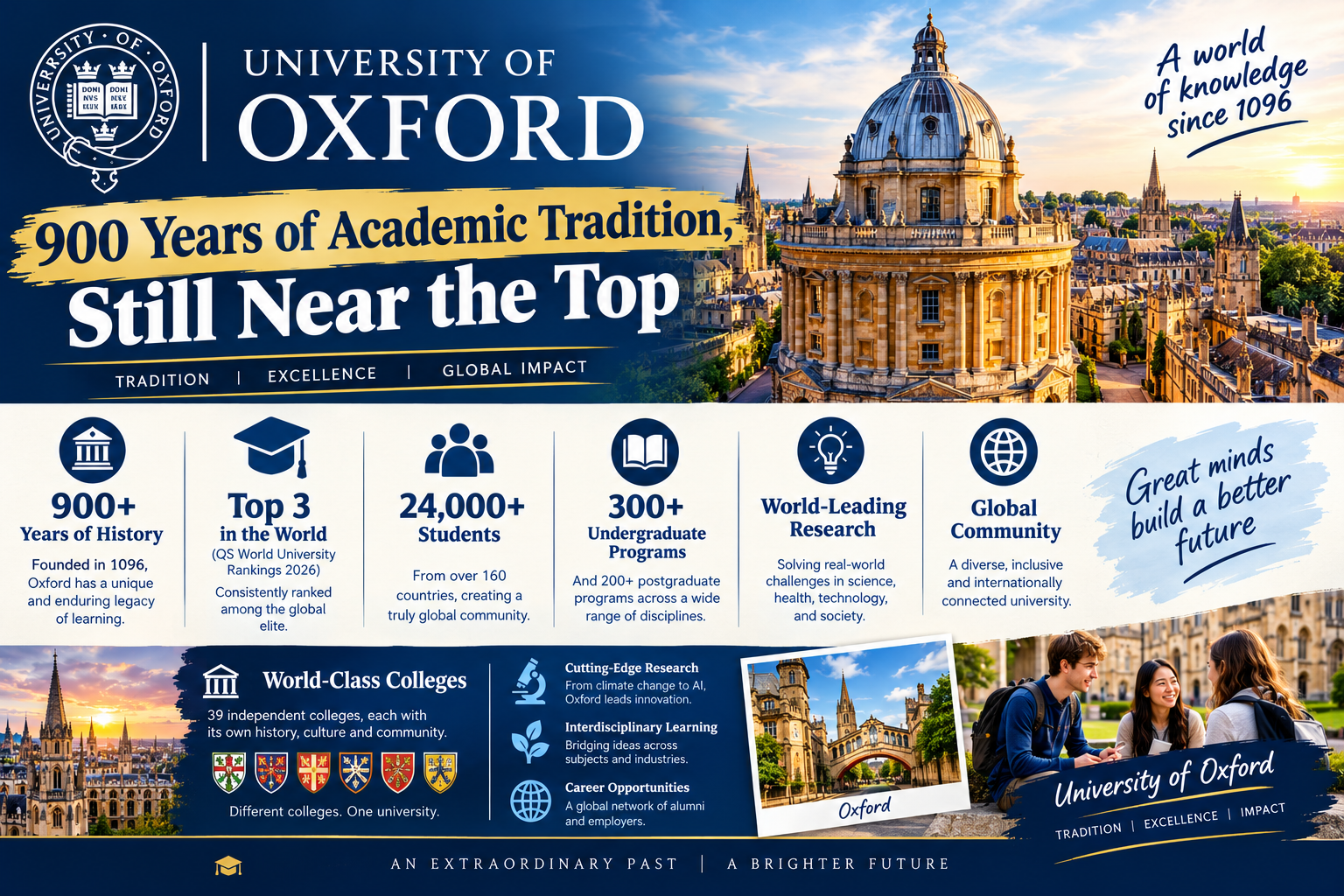
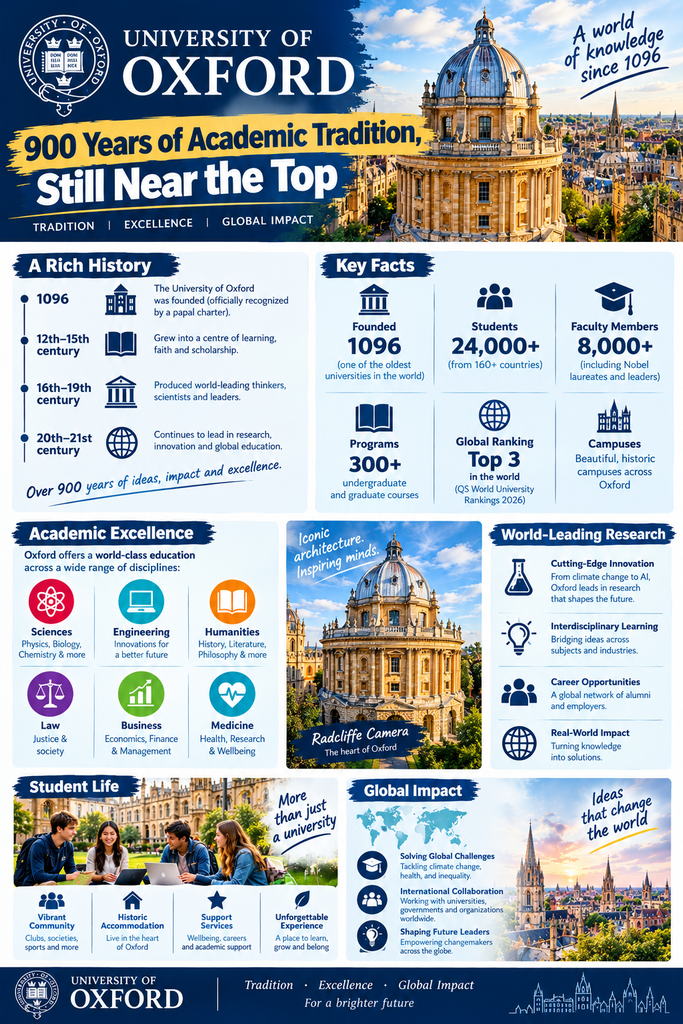
There’s no exact founding date for Oxford — that’s how old it is. Teaching is documented as far back as 1096, which makes it the oldest university in the English-speaking world by a wide margin. Sitting at fourth in the QS World University Rankings 2026, Oxford remains one of the small handful of institutions that has been globally relevant for nearly a millennium without ever really fading.
An Institution Built From Colleges
Oxford isn’t one single campus the way most universities are. It’s a federation of 39 independent colleges, each with its own buildings, dining halls, traditions, and admissions quirks, all loosely bound together under the university’s central administration. When you apply to Oxford, you’re applying both to the university and, usually, to a specific college — a system that confuses a lot of first-time applicants but shapes almost everything about student life once you’re there.
This structure dates back centuries and was originally meant to house and feed students in an era before dormitories and dining halls existed as we know them today. It’s stuck around because it works — smaller college communities inside a huge university give students a tight social circle without losing access to the resources of a massive institution.
Where Oxford Excels Academically
Oxford’s reputation is often associated with the humanities and social sciences — PPE (Philosophy, Politics and Economics) has produced an unusually large number of world leaders — but its strength runs much wider than that:
- Medicine, particularly biomedical research and clinical training
- Law, regularly ranked among the best programs anywhere
- History and English Literature, both drawing on centuries of institutional depth
- Physics and Chemistry, tied to Oxford’s long list of Nobel Prize-winning researchers
The tutorial system is what really sets Oxford apart from most other universities on this list. Instead of large lecture halls being the primary mode of teaching, students meet in small groups — sometimes just one-on-one — with a tutor to argue through ideas and defend written work every week. It’s intense, and it’s also exactly the kind of teaching model that produces the kind of independent thinkers Oxford is known for.
The Ranking Picture
Oxford dropped slightly from third to fourth in the most recent QS rankings, though the gap between the top four or five schools at this level is often razor-thin. Its academic reputation score remains near-perfect, and it continues to attract some of the strongest research funding of any university in Europe. The slight dip has more to do with other schools improving in specific metrics like sustainability and international faculty ratios than with Oxford declining in any meaningful sense.
Applying to Oxford
Admissions here work differently than at most universities. Beyond grades, many courses require the Oxford-specific admissions tests, and shortlisted candidates go through in-person or online interviews — a format that’s become something of a legend among prospective students. Acceptance rates vary by course and college but generally sit somewhere around 15%, higher than MIT or Stanford, though still highly competitive given the volume and quality of applicants.
Life Inside the Colleges
Oxford’s social life is built around its colleges — formal hall dinners, college bar nights, and rivalries between colleges that show up in everything from rowing competitions to academic bragging rights. The city itself is small and walkable, packed with centuries-old architecture that makes it feel less like a modern university town and more like stepping into a different century entirely.
Its alumni list includes more than two dozen British prime ministers, along with writers like Oscar Wilde and J.R.R. Tolkien, and scientists whose work still shapes entire fields today.
Research Beyond the Classroom
Oxford’s research reach extends well past its famous humanities reputation. The Jenner Institute and the Oxford Vaccine Group became globally known during recent years for vaccine research, work that drew directly on centuries-old expertise in medicine housed inside the university’s teaching hospitals. The Oxford Internet Institute, meanwhile, sits at the newer end of the university’s research portfolio, studying how technology reshapes society — a reminder that Oxford’s research isn’t frozen in its medieval origins, even if its buildings sometimes look that way.
Funding for this research comes from a mix of government grants, industry partnerships, and the university’s own endowment, along with money distributed through the individual colleges, each of which manages its own separate financial holdings. That layered funding structure — university-wide money plus 39 separately wealthy colleges — is genuinely unique among the world’s top universities.
Tuition and the Cost of Attending
For UK students, Oxford’s tuition is capped at the same government-set rate as every other English university, just over £9,000 a year, with living costs on top depending on the college. International students pay considerably more, with course fees ranging widely by subject — Medicine and some laboratory-based sciences sit at the higher end, often exceeding £35,000 a year, while humanities courses tend to cost less.
Financial support varies significantly by college, since each one holds its own endowment and sets its own bursary policies alongside university-wide scholarships. This means two students studying the same subject at Oxford can end up with meaningfully different financial aid packages depending purely on which college they were placed into.
Oxford Next to Its Closest Rival
The comparison with Cambridge is unavoidable and, honestly, a little overstated in how different the two actually are day to day. Both run near-identical collegiate and tutorial systems, both sit within a hair’s breadth of each other in every major ranking, and both draw from a similar applicant pool. The differences that do exist tend to be about subject strength rather than teaching quality — Oxford holds a slight edge in PPE, Law, and English, while Cambridge is generally seen as stronger in Mathematics and the physical sciences.
Compared to MIT or Stanford, the contrast is much bigger. Oxford’s tutorial-based teaching model rewards students who thrive on independent reading and verbal argument, while American research universities tend to lean more on lectures, problem sets, and lab work. Neither approach is inherently better, but they suit very different kinds of learners.
A Few Notes for Applicants
Oxford’s subject-specific admissions tests catch a lot of applicants off guard, since they test raw reasoning ability rather than curriculum knowledge in some cases. The interview stage, often built up into something intimidating in popular media, is described by most students who’ve been through it as more of an academic conversation than an interrogation — tutors are typically trying to see how a student thinks under gentle pressure, not trip them up.
Choosing a college matters less than most applicants assume. Oxford’s pooling system redistributes strong candidates across colleges if their first choice is oversubscribed, so a student rejected by one college for lack of space, rather than lack of merit, often ends up placed at another with room available.
Why Oxford Still Matters
In a ranking system that increasingly rewards research metrics and international recruitment, Oxford’s continued place near the top says something important: raw institutional history and a genuinely distinctive teaching model still carry real weight, even against much younger, more narrowly focused competitors.