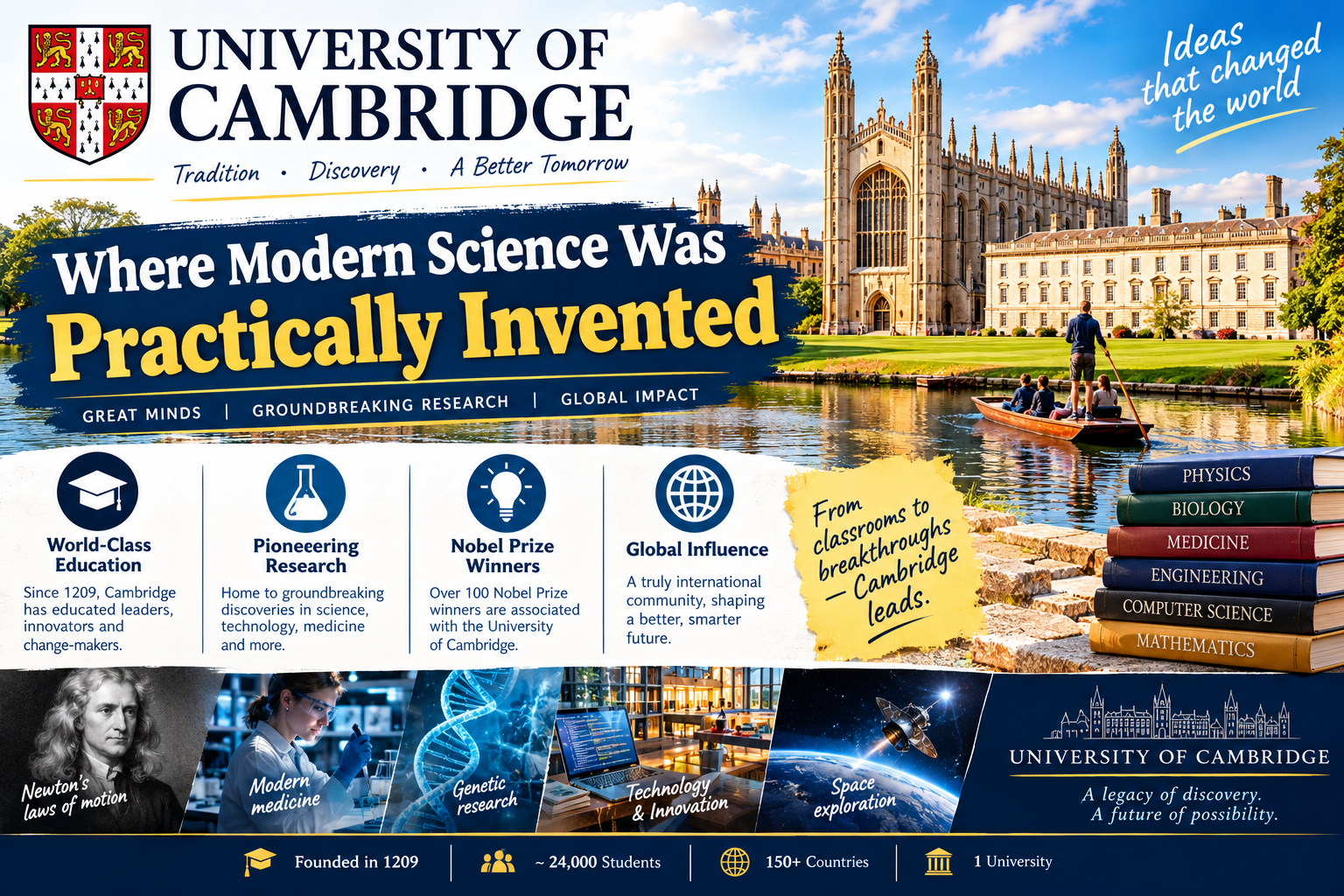
The list of scientific breakthroughs tied to a single university is rarely as long as Cambridge’s. DNA’s structure, the electron, the theory that laid groundwork for the modern computer — all of it traces back to labs and lecture halls at this one English university, which currently sits at sixth place in the QS World University Rankings 2026.
Born From a Dispute at Oxford
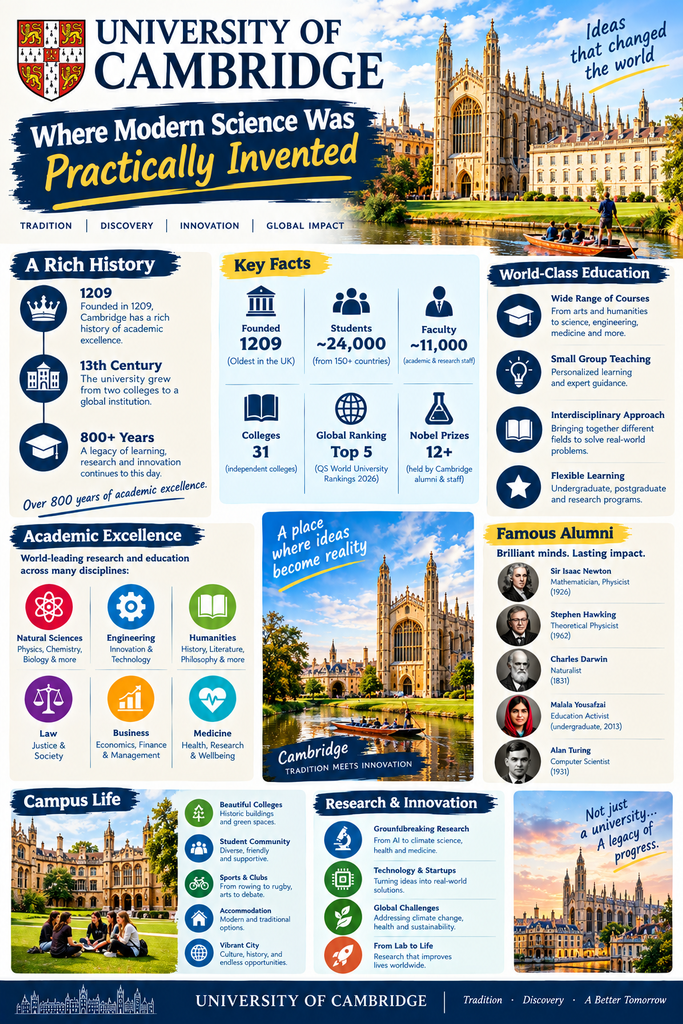
Cambridge’s origin story is genuinely unusual: it was founded in 1209 by scholars who fled Oxford after a dispute with local townspeople turned violent. That rivalry between the two — often shortened to “Oxbridge” when people talk about them together — has lasted over 800 years and shows no sign of cooling off, even as both schools remain firmly in the world’s top ten.
Like Oxford, Cambridge is organized around a collegiate system — 31 colleges, each independently endowed, each with its own personality, architecture, and admissions process layered underneath the central university.
Academic Strengths
Cambridge’s reputation in the sciences is hard to overstate. The Cavendish Laboratory alone has produced dozens of Nobel Prize winners since it opened in 1874, and the university’s list of scientific firsts reads like a history of modern physics and biology combined:
- Physics, home to the discovery of the electron and the neutron
- Natural Sciences broadly, one of the most flexible and rigorous programs of its kind
- Mathematics, long considered among the most demanding undergraduate math courses in the world
- Computer Science, tied historically to Alan Turing’s work and modern ties to the UK tech sector
Teaching follows the same supervision system Oxford uses — small group sessions, sometimes one-on-one, built around weekly essays or problem sets that get picked apart and defended in real time.
Reading Into the Ranking
Cambridge sits just behind Oxford in the current QS rankings, a gap that’s mostly a matter of small differences across a handful of metrics rather than any real distinction in academic quality. Its research citation numbers remain exceptionally strong, particularly in the physical sciences, and its academic reputation score is close to perfect, much like Oxford’s.
Getting In
Cambridge’s admissions process closely mirrors Oxford’s — subject-specific entrance tests for many courses, followed by interviews for shortlisted applicants. Acceptance rates hover around 20% overall, though this varies enormously by subject and college, with competitive courses like Medicine or Computer Science running far lower.
Applicants typically choose a specific college when applying, though Cambridge also runs a pooling system that redistributes strong candidates to colleges with more space if their first choice is oversubscribed.
Life in the Colleges
Cambridge’s city center is small, flat, and built for cycling — bicycles are practically the default mode of transport for students moving between colleges, labs, and lecture halls. Formal hall dinners, punting on the River Cam, and long-standing inter-college rivalries fill out student life outside the library.
Alumni include Isaac Newton, Charles Darwin, Stephen Hawking, and a long list of Nobel laureates that outnumbers those of most entire countries. Few universities anywhere can claim to have shaped the actual foundations of modern science the way Cambridge has.
The Cavendish Legacy and Modern Research
It’s hard to overstate what the Cavendish Laboratory alone has contributed to modern physics. J.J. Thomson discovered the electron there in 1897. James Chadwick found the neutron there in 1932. Watson and Crick worked out the double-helix structure of DNA just down the road at the Cambridge-affiliated MRC Laboratory of Molecular Biology in 1953. Very few buildings on earth can claim to have hosted this many field-defining discoveries under one roof.
That legacy continues today through the Cambridge Institute for Medical Research, the Department of Engineering, and a growing cluster of AI and biotech research tied to “Silicon Fen” — the local nickname for Cambridge’s own tech corridor, considerably smaller than Silicon Valley but built on the same idea of university research spinning directly into private companies. ARM Holdings, the chip design company behind processors in most of the world’s smartphones, traces its roots directly back to Cambridge research and remains headquartered in the city today.
Tuition and Financial Support
Cambridge’s fee structure mirrors Oxford’s closely, since both operate under the same UK government tuition cap for home students, just over £9,000 a year. International tuition varies by course, with laboratory-based sciences and Medicine sitting at the higher end, often above £35,000 annually. As with Oxford, financial support is split between university-wide bursaries and college-specific funding, meaning the exact aid package a student receives depends partly on which of the 31 colleges they end up in.
Cambridge’s colleges vary enormously in wealth — some, like Trinity College, hold endowments larger than many entire universities elsewhere in the world, while smaller colleges operate on far tighter budgets. This affects everything from library resources to the quality of student accommodation, something prospective applicants rarely account for when picking a college.
Cambridge Compared to the Rest of the Top Six
The Oxford comparison dominates any discussion of Cambridge, and for good reason, but the more interesting contrast might be with MIT. Both universities lean unusually hard into mathematics and the physical sciences relative to their overall size, and both have produced a disproportionate number of Nobel laureates in physics specifically. Where they diverge is teaching style — Cambridge’s supervision system rewards students who can think and argue on their feet in small, intense sessions, while MIT’s project-based, lab-heavy approach suits students who learn best by building and testing things directly.
Against Harvard, the difference in scale and cultural weight is significant. Harvard’s influence spreads across law, politics, and business as much as science, while Cambridge’s global reputation still rests overwhelmingly on its scientific and mathematical output, even though it maintains strong humanities departments as well.
Advice for Prospective Applicants
Cambridge’s admissions tests differ by subject, and preparing for them properly usually means going well beyond standard secondary school curriculum — the Mathematics admission process in particular is known for testing problem-solving approaches rather than memorized techniques. Interviews follow a similar academic-conversation format to Oxford’s, with supervisors typically more interested in how a candidate reasons through an unfamiliar problem than whether they land on the “right” answer immediately.
As with Oxford, Cambridge’s pooling system means a strong candidate rejected by an oversubscribed college may still be offered a place at another college with space available, so a rejection from one specific college isn’t always a rejection from the university as a whole.
Why It Still Ranks Among the Best
Cambridge’s place at sixth globally isn’t a story of decline — it’s a reflection of just how tightly bunched the world’s elite universities have become at the very top. Separated from Oxford by a fraction of a point and from Harvard by not much more, Cambridge remains exactly what it’s been for eight centuries: one of the handful of places where the boundaries of human knowledge actually get pushed forward.